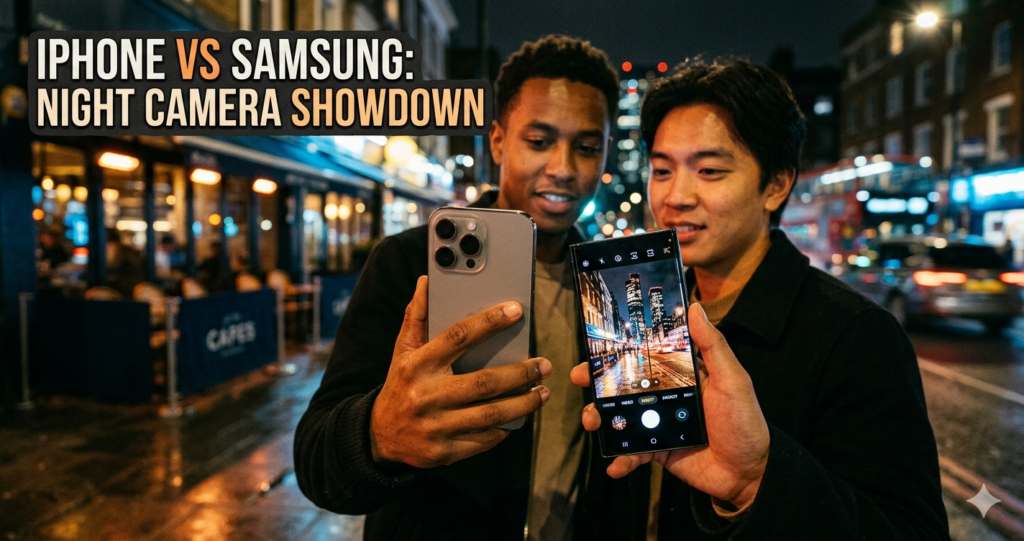
The age-old debate between iPhone vs Samsung has reached a fever pitch, especially when the sun goes down. As we move through 2026, smartphone sensors have evolved into low-light monsters, turning pitch-black alleys into detailed masterpieces. If you have ever struggled to capture a clear photo at a candlelit dinner or under a starry sky, you know that not all “Night Modes” are created equal.
In this guide, we dive deep into the night photography battle between the iPhone 17 Pro Max and the Samsung Galaxy S26 Ultra. We will break down the hardware, the software, and the real-world results to help you decide which flagship deserves a spot in your pocket for your next late-night adventure.
What is Night Photography and Why it Matters
Night photography in the smartphone world refers to a device’s ability to capture high-quality images in low-light environments without using a harsh, artificial flash. It matters because life’s most atmospheric moments—festivals, cityscapes, and intimate gatherings—rarely happen under perfect lighting.
For years, small smartphone sensors struggled with “noise” (graininess) and motion blur in the dark. However, with the introduction of iPhone’s Night Mode and Samsung’s Nightography, these devices now use “computational photography.” This means the phone isn’t just taking one photo; it’s taking dozens in a fraction of a second and stitching them together to create a bright, clear image. Choosing the right tool determines whether your memories look like professional art or a blurry, pixelated mess.
Step-by-Step Guide: How to Master Night Mode
Regardless of which brand you choose, getting the perfect shot requires a bit of technique. Here is how to use the advanced night features on both devices:
-
Steady Your Grip: Both phones use long exposure (1–3 seconds). Any movement can cause blur, so tuck your elbows into your sides or lean against a wall.
-
Enable the Feature: On an iPhone, Night Mode activates automatically when it detects low light (look for the yellow moon icon). On Samsung, you can find “Night” under the “More” tab or let the AI Scene Optimizer kick in.
Adjust Exposure Time: Tap the moon icon on the iPhone or the settings in Samsung’s Night mode to manually increase the timer to “Max” for darker scenes.
-
Focus and Lock: Tap on the brightest part of the subject (like a streetlamp or a face) to ensure the AI balances the highlights correctly.
Use a Remote Shutter: If you have a Samsung, use the S Pen as a remote shutter to avoid “tap-shake.” iPhone users can use an Apple Watch or the volume buttons on wired headphones.
The Math & Formula Behind the Lens
The “magic” of night photography is actually a mix of physics and algorithms. The core formula involves Light Gathering + Multi-Frame Integration.
Samsung utilizes a 200MP Adaptive Sensor. Through a process called Pixel Binning, it merges 16 small pixels into one “Super Pixel,” effectively acting like a much larger sensor to soak up more light.
Apple focuses on Photonic Engine logic. It applies Deep Fusion early in the processing pipeline, working on uncompressed data to preserve dynamic range. While Samsung’s $f/1.4$ aperture (on the S26 Ultra) physically lets in more light, Apple’s software focuses on Signal-to-Noise Ratio (SNR), ensuring that the light captured is “cleaner” and truer to what the human eye actually sees.
Real-Life Scenarios: iPhone vs. Samsung
To see who wins, let’s look at three common nighttime situations:
-
The Neon Cityscape: You are standing in Times Square. The iPhone excels here by keeping the neon signs sharp without “blowing out” the colors. Samsung tends to brighten the shadows more, making the buildings visible but sometimes losing the “mood” of the night.
-
The Starry Sky (Astrophotography): Samsung is the undisputed king here. Using its 300x Hyperlapse and dedicated “Star Trails” mode, you can capture the rotation of the stars. The iPhone produces a beautiful, clean sky but lacks the specialized tools for deep-space detail.
-
The Moving Subject: Trying to take a photo of a friend walking at night? The iPhone 17 Pro Max typically wins. Its shorter shutter lag and superior stabilization mean less “ghosting” on moving people compared to Samsung’s slightly slower processing.
FAQs: Top 3 Questions Answered
1. Does a higher Megapixel count mean better night photos?
Not necessarily. While Samsung’s 200MP sensor captures incredible detail in daylight, at night, the phone “bins” those pixels down to 12MP or 24MP to reduce noise. The quality of the software processing is often more important than the raw megapixel count.
2. Should I always use a tripod for Night Mode?
While modern Optical Image Stabilization (OIS) allows for great handheld shots, a tripod is essential for exposures longer than 3 seconds (like capturing the Milky Way).
3. Which phone has a better selfie camera at night?
Recent tests show the iPhone holds a slight edge in skin tone accuracy and “TrueDepth” processing in low light, whereas Samsung sometimes over-smoothes the skin in its “Nightography” mode.
Conclusion & CTA
The choice boils down to your personal style: iPhone is for those who want “Point-and-Shoot” reliability and truer-to-life colors. Samsung is for the power user who wants the best zoom and specialized modes like Astrophotography.
Ready to upgrade your mobile photography game? Check out our latest comparison charts on the TechNova1 blog to see side-by-side unedited samples!