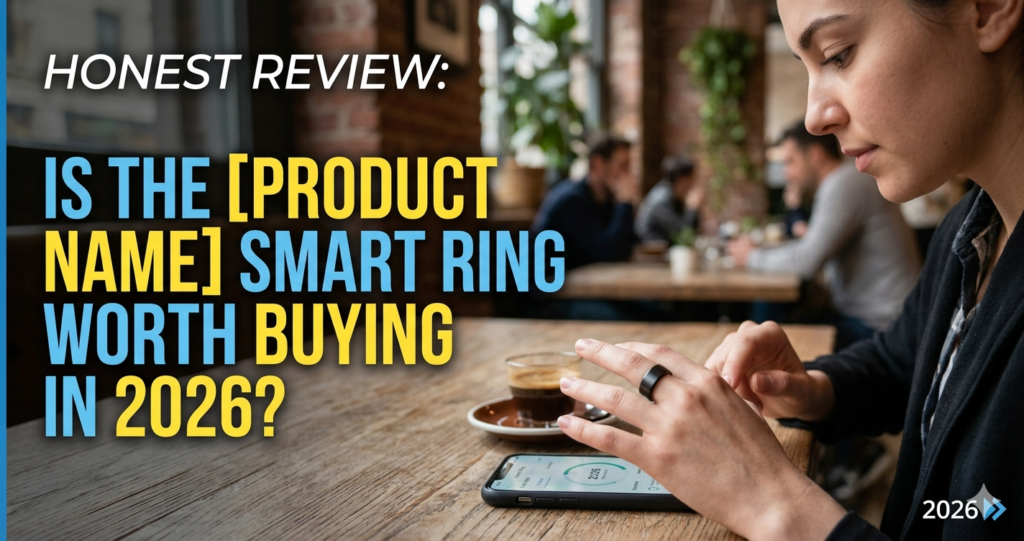
The “Smart Ring” has transitioned Honest Review from a niche gadget for biohackers into a mainstream powerhouse. As we navigate 2026, the question on every tech-enthusiast’s mind isn’t just about what a wearable can do, but how invisibly it can do it. With major players like Samsung, Oura, and even high-fashion collaborations dominating the market, you might be wondering if it’s time to ditch the bulky smartwatch for something more discreet.
The problem with traditional wearables has always been the “screen fatigue” and the constant buzzing on your wrist. A Smart Ring solves this by shifting the focus from notifications to deep, actionable data. It tracks your health from the underside of your finger—where pulse detection is often more accurate than the wrist—providing a sleek, professional alternative for those who want to monitor their wellness without looking like they’re wearing a mini-computer.
What is a Smart Ring and Why it Matters
A Smart Ring is a compact, sensor-packed wearable designed to monitor health metrics like heart rate, sleep stages, blood oxygen ($SpO_2$), and skin temperature. Unlike smartwatches, these devices lack a screen, sending all gathered data to a dedicated smartphone app via Bluetooth.
In 2026, the importance of the Smart Ring lies in its holistic approach to health. As preventive healthcare becomes a priority, these rings offer “Wearables 3.0” capabilities—predictive analytics that can warn you of an oncoming illness or high stress levels before you even feel the symptoms. Because they are lightweight and have a battery life that often lasts 5–7 days, they provide a much more consistent data stream than watches that need nightly charging. For the modern professional or athlete, it represents the perfect balance between style and substance.
Step-by-Step Guide: How to Use Your Smart Ring
Getting the most out of your ring requires more than just putting it on. Follow these steps to ensure peak performance:
-
Find Your Perfect Fit: Use the manufacturer’s sizing kit before ordering. Wear the plastic sizing ring for 24 hours to account for finger swelling throughout the day and night.
-
Optimal Placement: Wear the ring on your index or middle finger. The sensors (usually small bumps on the inside) must stay positioned against the palm side of your finger for accurate readings.
-
Initial Calibration: Wear the ring consistently for the first 14 days. This allows the AI to establish your “baseline” for heart rate variability (HRV) and temperature.
-
Review Your Morning Readiness: Every morning, check your “Readiness Score” or “Energy Score.” Use this data to decide if you should push through a hard workout or opt for a recovery day.
-
Sync with Health Ecosystems: Connect your ring’s app to Apple Health, Google Fit, or MyFitnessPal to correlate your activity with your nutrition and sleep data.
The Math Behind the Magic: How It Works
The core technology inside a Smart Ring is Photoplethysmography (PPG). While that sounds complex, the formula is rooted in how light interacts with your blood flow.
The ring emits light (usually green, red, or infrared) into the skin. As your heart beats, the volume of blood in your finger changes, absorbing and reflecting light differently. The sensors calculate the Reflected Light Intensity ($I_r$) using the following principle:
By measuring the change in $I_r$ over time, the ring determines your heart rate. Furthermore, by comparing the absorption of red light versus infrared light, the device can calculate your oxygen saturation ($SpO_2$) using the R-Ratio:
This data is then processed through advanced algorithms to filter out “noise” (like hand movement), giving you a clean window into your internal health.
Real-Life Scenarios: When the Investment Pays Off
To understand the value, let’s look at how a Smart Ring functions in the real world:
-
The Busy Executive: Sarah wears her ring to high-stakes meetings. While a smartwatch would look distracting and feel clunky under her blazer, the ring remains invisible. On Tuesday, her ring flags an unusually low HRV and a slight rise in body temperature. Taking the hint, she cancels her late-night gym session, avoiding a full-blown flu that would have ruined her Friday presentation.
-
The Sleep-Struggler: Mark hasn’t felt rested in months. After wearing a Smart Ring for three weeks, the data shows he is experiencing high “latency” (taking too long to fall asleep) and frequent “micro-awakenings.” The app suggests he move his last meal two hours earlier. Within a month, his deep sleep increases by 20%, significantly boosting his daily productivity.
FAQs: Everything You Need to Know
1. Is a Smart Ring better than an Apple Watch?
It depends on your goal. If you want GPS, calls, and apps, a watch is better. If you want superior sleep tracking, a 7-day battery, and a screen-free life, the ring is the winner.
2. Can I wear it while lifting weights?
While many rings are durable (Titanium/Ceramic), it is generally recommended to remove them or wear a protector when lifting heavy metal barbells to avoid “ring avulsion” or scratching the finish.
3. Are there monthly subscription fees?
This is the biggest “catch” in 2026. While some brands like Samsung offer all features for free, others like Oura require a monthly membership (usually around $6) to access your detailed data.
Conclusion & CTA
Is the Smart Ring worth it in 2026? Absolutely. If you value long-term health insights and a minimalist aesthetic, it is the most refined wearable on the market today. It stops being a “gadget” and starts being a silent partner in your wellness journey.
Ready to upgrade your health? Check out our top-rated Smart Rings for 2026 and find the one that fits your lifestyle!