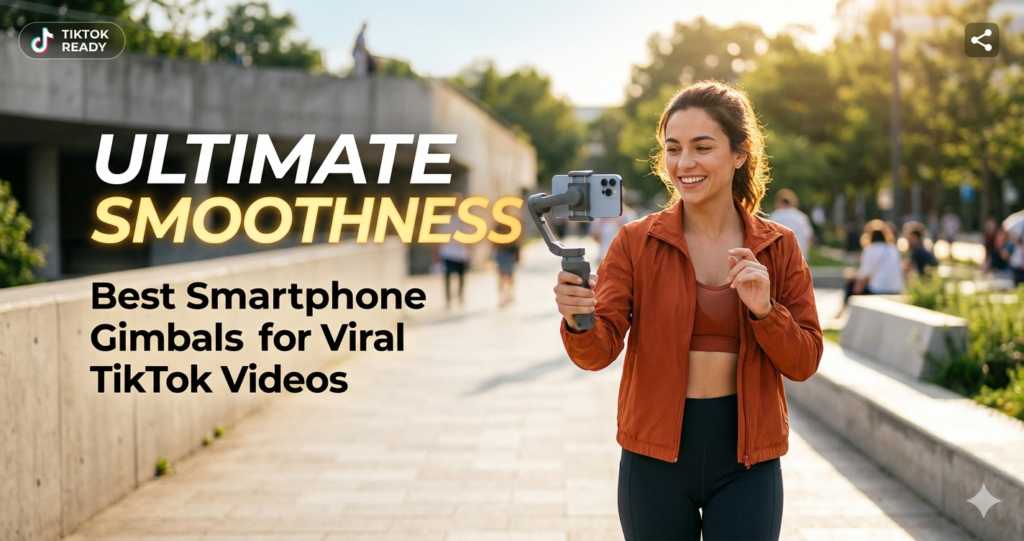
In the fast-paced world of TikTok, viewers decide Ultimate Smoothness within seconds whether to stay or scroll. If your footage is shaky or poorly framed, they are gone. High-quality, cinematic motion is no longer a luxury reserved for professional filmmakers; it is the standard for anyone wanting to hit the “For You” page.
Whether you are performing a complex dance routine, capturing a cinematic transition, or vlogging your daily life, a smartphone gimbal is the secret weapon that separates viral hits from amateur clips. These devices don’t just stabilize your phone; they act as an AI-powered camera crew that follows your every move. This guide dives into the top gimbals of 2026 that will transform your smartphone into a viral content machine.
What is a Smartphone Gimbal and Why It Matters
A smartphone gimbal is a handheld motorized stabilizer that uses brushless motors and intelligent sensors to counteract unwanted movement. Unlike the built-in electronic stabilization in most phones, which often crops your image and struggles in low light, a gimbal provides physical, mechanical stabilization across three axes: Tilt, Pan, and Roll.
For TikTok creators, a gimbal matters because it unlocks “impossible” shots. Features like AI Subject Tracking allow you to set your phone on a tripod and move freely while the gimbal automatically rotates to keep you centered. It eliminates the “micro-jitters” that happen when you walk, and it provides professional cinematic modes like “Inception Mode” (360° rolls) and “Hitchcock Zooms” that grab attention instantly. In an ecosystem where visual quality correlates directly with engagement, a gimbal is the bridge between a hobbyist and a professional digital publisher.
Step-by-Step Guide: How to Use Your Gimbal for Viral Clips
Mastering a gimbal is easier than it looks, but the setup is crucial for protecting the motors and getting the smoothest results.
-
Balance First: Before turning the power on, slide your phone into the clamp and adjust its position until it stays level on its own. If the gimbal is “fighting” an unbalanced phone, the motors will overheat and shake.
-
The “Ninja Walk”: Even with a gimbal, your footsteps can cause vertical bounce. Walk with slightly bent knees and roll your feet from heel to toe to minimize upper-body movement.
-
Switch to Follow Mode: For most TikToks, use Pan Follow (PF) or Follow (F) mode. This ensures the camera follows your side-to-side movements smoothly while keeping the horizon level.
-
Utilize Gesture Control: Most modern gimbals allow you to start recording or enable tracking just by showing a “V” sign or a palm to the camera. This is perfect for solo creators.
-
Shoot Vertically: Ensure your gimbal is toggled to Portrait Mode. Modern stabilizers like the DJI Osmo Mobile 7P or Insta360 Flow 2 Pro allow you to switch orientation with a quick double-tap of a button.
The Math and Science Behind the Stability
At the heart of every gimbal is a complex system called the IMU (Inertial Measurement Unit) and a PID Controller. The IMU consists of gyroscopes and accelerometers that detect the exact speed and angle of your hand’s movement in real-time.
The math works through a feedback loop. When the sensors detect a tilt of 5° to the left, the processor calculates the exact amount of electrical current needed to move the motor 5° to the right. This happens thousands of times per second. This is expressed by the formula:
In simple terms, $K_p$ handles the current error, $K_i$ looks at past errors to ensure the camera stays level over time, and $K_d$ predicts future movements to stop the camera from overshooting. This “predictive” math is what makes the footage look “floaty” and cinematic rather than jerky.
Real-Life Scenarios for TikTok Creators
To see how a gimbal changes the game, consider these common TikTok filming scenarios:
-
The “Fit Check” Transition: Imagine you are walking toward the camera, then jumping into a new outfit. Without a gimbal, the walk is shaky. With a Hohem iSteady V3, you can use the AI tracking sensor to lock onto your face, ensuring the “jump” stays perfectly centered in the frame for a seamless edit.
-
The Cinematic Product Reveal: If you are a tech reviewer or pet vlogger, you might want to “orbit” around an object. By using FPV Mode, the gimbal allows you to tilt and pan freely while maintaining a “fluid” feel, making a simple $20 product look like a high-end commercial.
-
The High-Energy Dance: Fast movements often cause phones to lose focus. Using ActiveTrack 7.0 on the DJI Osmo Mobile 8, the gimbal’s motors move fast enough to keep up with your choreography, even if you move to the edge of the frame.
FAQs: Common Questions About Smartphone Gimbals
1. Do I need a gimbal if my phone has “Action Mode” or OIS?
Yes. While phone software is great, it often fails in low light and cannot physically rotate to track you. A gimbal provides a wider field of view (no cropping) and mechanical movement that software cannot replicate.
2. Will a gimbal work with my heavy phone case?
Most 2026 models like the Hohem iSteady M7 support payloads up to 500g, which is plenty for an iPhone 17 Pro Max with a case. Always check the “Max Payload” spec before buying.
3. Is the DJI Mimo or Insta360 app necessary?
While you can use the native camera app, the dedicated apps unlock the “viral” features like AI editing, 360° panoramas, and advanced object tracking. However, newer gimbals now support Apple DockKit, allowing native tracking in TikTok itself.
Conclusion & CTA
Elevating your TikTok game starts with getting the right tools. A gimbal isn’t just a tripod; it’s a creative partner that ensures your hard work isn’t ruined by shaky footage. For the best balance of portability and power, the Insta360 Flow 2 Pro is a top choice, while those needing professional lighting should look at the DJI Osmo Mobile 7P.